
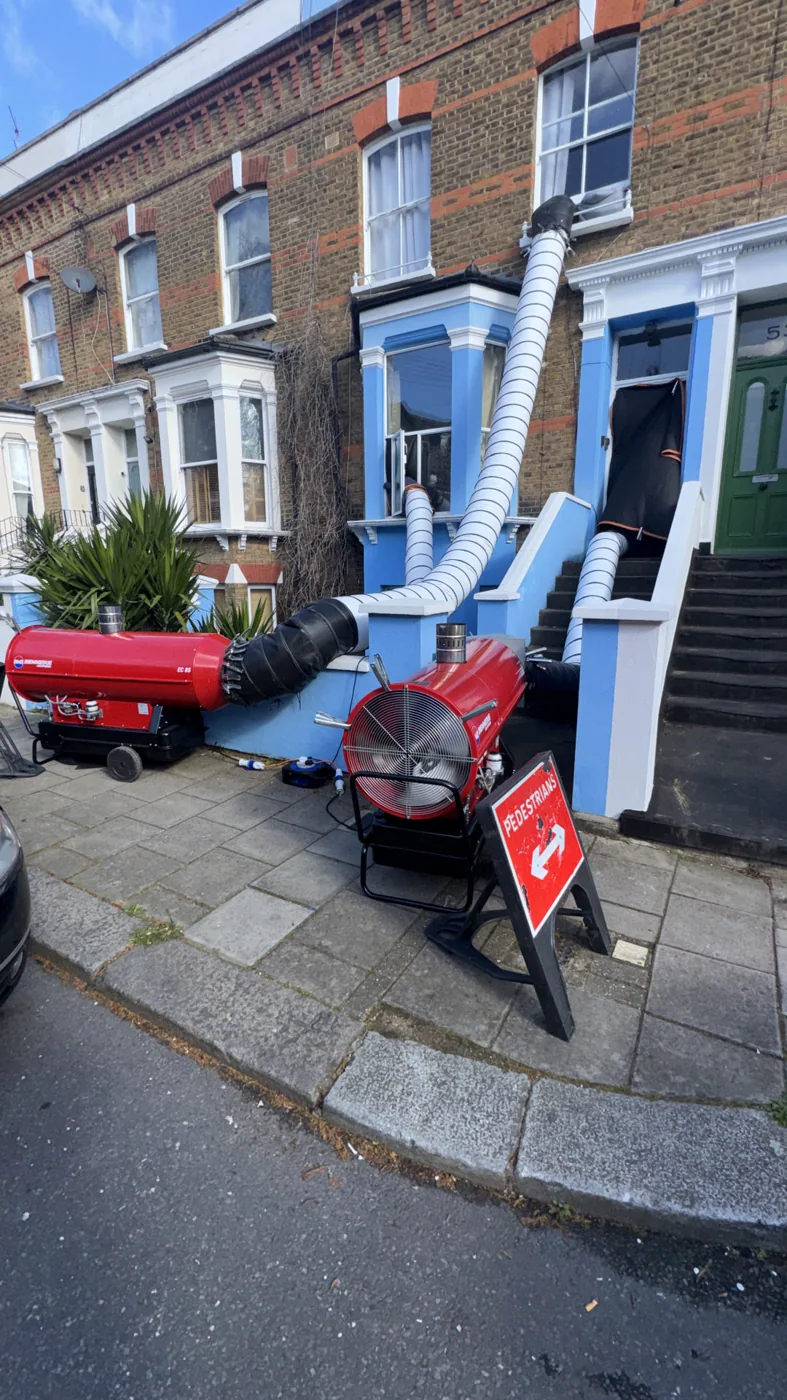
A hot room does not necessarily mean a fully treated room.
Professional bed bug heat treatment is more complicated than simply placing a powerful heater inside a property. A room may reach an extremely high air temperature while the interior of a mattress, sofa, wooden bed frame or other furniture remains considerably cooler.
Bed bugs and their eggs can hide in protected areas where heat takes longer to penetrate. A properly engineered treatment must therefore combine heat production, effective air circulation, heat penetration and temperature monitoring.
The objective is not simply to make a room hot. It is to ensure that relevant harbourages receive an effective temperature exposure for an appropriate duration.
Industrial heat generators
Energy production is only the beginning.
Industrial heat generators provide the energy needed to warm the property and its contents. Equipment selection must consider the size of the building, insulation, heat losses, furnishings and thermal mass.
Professional systems may use purpose-designed electric heaters or appropriately installed indirect-fired heating equipment. With indirect-fired equipment, combustion products are separated from the delivered heated air through a heat exchanger.
Where a heater is designed for outdoor operation, it should remain outside, delivering heated air through compatible ducting. Combustion exhaust must be managed safely to prevent fumes entering the building. Indirect-fired does not mean that every installation is automatically safe: the equipment design and its installation requirements still matter.
Powerful heaters alone do not guarantee effective treatment. Heat must reach the relevant harbourages, rather than simply create high temperatures beside the outlet.
Thermal stratification
Why hot ceilings can hide cooler conditions below.
Warm air is generally less dense than cooler air. Without adequate circulation, warmer air can accumulate near the ceiling while lower areas remain cooler. This is called thermal stratification.
It can create substantial temperature differences inside a room. A ceiling thermometer might show a high temperature while furniture and protected lower-level areas are still warming. A measurement is meaningful only when its location is understood.
One room. Different temperatures.
Industrial air movers
Why airflow matters as much as heat output.
Industrial air movers help distribute heated air throughout the treatment area. They reduce thermal stratification, mix warmer and cooler air, improve circulation around furniture, reduce stagnant areas and improve convective heat transfer. This helps difficult-to-heat locations warm more consistently.
Correct fan positioning depends on the room layout, heat supply and measured temperatures. Simply adding more fans does not guarantee better performance. The objective is effective circulation throughout the treatment area, not an impressive number of machines.
Some professionally engineered systems have integrated circulation, so separate portable fans are not universally required. The essential requirement is effective heat distribution and verified exposure.
The cost of inadequate circulation
Heated air accumulates in upper areas while lower areas remain cooler.
Protected areas behind and beneath furniture may receive less heat.
Mattresses, sofas and substantial objects may take longer to warm internally.
A high air-temperature reading may not reflect temperatures inside furniture.
Poor distribution can delay the heating of difficult locations.
Insects or eggs in locations without adequate exposure may survive.
The science of heat penetration
The surface warms first. The interior takes time.
Heat transfers through three main mechanisms. Convection occurs when moving heated air transfers energy to exposed surfaces. Conduction moves heat through materials from warmer regions to cooler regions. Radiation allows surfaces to exchange thermal energy. These processes work together.
Different materials heat at different rates. The interior of a thick mattress or upholstered sofa can remain cooler than its outer surface for some time. This delay is known as thermal lag. Surface temperature and internal temperature are not interchangeable.
Furniture, walls and flooring absorb energy as they warm. Large mattresses, sofas and substantial wooden furniture can require significant energy to heat. This is thermal mass: a heavily furnished room may take longer to reach suitable treatment conditions than an empty room of the same size.
Treatment planning must therefore consider the contents of the property, not simply the floor area. Airflow helps heat reach exposed surfaces, but the transfer into deeper materials still takes time.
The surface warms first. The core takes time.
Moving air warms exposed surfaces.
Heat moves deeper into the material.
The protected core warms more slowly.
High-temperature ducting & splitters
Delivering heat is an engineering task.
Suitable ducting delivers heated air from industrial equipment to the treatment area. Duct length, diameter, bends, restrictions and splitters can affect airflow. Where ducting branches are used, airflow may not be divided equally.
Technicians must assess actual performance rather than assume that every duct outlet receives identical heat. An obstruction or an unsuitable arrangement can reduce delivery to one part of a property even when the heater itself is operating.
All ducting and accessories must be compatible with the heater and operating temperatures. Manufacturer requirements and a property-specific safety assessment take precedence over any simplified diagram.
Industrial systems vs portable LPG heaters
A space heater is not a treatment system.
Ordinary portable LPG space heaters are not equivalent to professional industrial bed bug heat-treatment systems. Small heaters may struggle to warm large rooms and heavily furnished properties. Very hot air near a heater does not prove that hidden harbourages have received effective exposure.
Incomplete combustion can produce dangerous carbon monoxide. Fuel-fired heaters require appropriate ventilation, safe positioning and manufacturer-compliant operation. Direct-fired LPG heaters release water vapour into the heated space, and nearby furnishings may be exposed to excessive temperatures.
The US Environmental Protection Agency warns against attempting to kill bed bugs by increasing indoor temperatures with a thermostat, propane space heater or fireplace, describing this as ineffective and dangerous. This is not a DIY heater operating guide.
Do not confuse unsuitable portable heating appliances with suitable, properly installed professional equipment. It would be incorrect to claim that all professionally engineered gas-fired systems are ineffective. The distinction is equipment suitability, installation, controlled distribution and verified exposure.
Engineered professional systems
- Equipment selected for the property and its contents
- Compatible ducting and controlled heat distribution
- Safe installation and combustion-exhaust management
- Relevant temperatures and exposure monitored
Ordinary portable LPG heaters
- Space heating is not a validated bed bug protocol
- Local heat does not establish hidden-area exposure
- Combustion, moisture and fire hazards require attention
- No assurance of adequate heat penetration
Professional thermal imaging
Understanding how heat moves through a property.
At Bed Bug Heat Control UK, we use professional thermal imaging cameras during our industrial heat treatments.
Thermal imaging allows our technicians to examine temperature patterns across visible surfaces and identify areas that appear cooler than their surroundings.
This is particularly useful when assessing heat distribution around beds, furniture, walls and other parts of the treatment area.
Thermal imaging helps our technicians:
- Identify potential cooler surface areas.
- Assess uneven heating patterns.
- Investigate areas where heat circulation may be restricted.
- Observe how exposed surfaces warm during treatment.
- Make informed adjustments to the heating and airflow arrangements.
Thermal imaging cameras primarily measure apparent surface temperatures. They do not directly measure temperatures deep inside mattresses, sofas or wooden furniture.
For this reason, thermal imaging findings must be interpreted alongside an understanding of heat transfer, furniture construction, treatment duration and the limitations of the equipment.
Our approach combines industrial heating equipment, circulation fans, thermal imaging and professional experience.
What temperature kills bed bugs?
Temperature and exposure time belong together.
Bed bugs and their eggs can be killed when they receive sufficiently high temperatures for an adequate duration. Both temperature and exposure time matter. Eggs can be more heat tolerant than other life stages, and published research examines several effective temperature-and-time combinations.
The relevant exposure is at the location being treated. It must not be confused with the temperature of the heater outlet or ceiling air. Professional systems may operate with hotter circulating air to transfer energy into cooler materials.
Excessive temperatures can damage furniture and building materials. The objective is effective exposure while managing safety, not simply to achieve the highest possible display reading. A validated protocol and suitable measurements are more informative than an isolated number.
Ask where the temperature was measured, whether difficult-to-heat areas were assessed, how long effective temperatures were maintained, whether heat was adequately distributed and whether potential cold spots were investigated. A professional treatment relies on measured exposure, not extreme heat claims.
Getting hot is only the beginning.
Independent evidence: Kells & Goblirsch’s temperature-and-time research. For further context, see what temperature kills bed bugs and their eggs.
The professional treatment process
Eight stages. One coordinated treatment.
- 01
Property assessment
Examine the infestation, room layout and likely harbourages.
- 02
Preparation & safety
Assess heat-sensitive items, building systems and equipment hazards.
- 03
Equipment planning
Select suitable heaters, ducting, circulation equipment and monitoring.
- 04
Controlled heating
Deliver heat using appropriately designed equipment.
- 05
Airflow management
Assess circulation and address significant temperature differences.
- 06
Thermal imaging checks
Scan exposed surfaces and investigate cooler, slow-heating areas.
- 07
Exposure verification
Confirm the protocol’s required temperature and exposure conditions.
- 08
Completion & aftercare
Complete safety checks, document treatment and provide aftercare advice.
Why professional expertise matters
Effective heat treatment requires knowledge of building construction, heat transfer, insect harbourages, equipment, airflow and temperature monitoring. Industrial machinery is only one part of the process. The technician must understand how heat behaves throughout a real property and how to verify the intended treatment conditions.
This explanation is educational, not a guide to operating heaters yourself. Follow the property-specific instructions supplied by your treatment provider and read our professional treatment preparation guide before an appointment.
Frequently asked questions
Can a room reach 65°C while bed bugs survive?
Yes. Protected areas inside furniture may remain cooler than the surrounding air. Bed bugs can survive where exposure is insufficient.
Why are fans used during bed bug heat treatment?
Fans help circulate heated air, reduce thermal stratification and improve heat transfer around furniture.
Can heat treatment work without separate fans?
Some professionally designed systems incorporate effective circulation. What matters is verified heat distribution and exposure.
Are small portable gas heaters suitable for bed bug treatment?
Ordinary portable gas space heaters are not an appropriate substitute for professionally engineered heat-treatment equipment and can present serious safety hazards.
Can a thermal camera prove all bed bugs are dead?
No. Thermal imaging measures apparent surface temperatures and cannot directly measure temperatures deep inside furniture. Its findings are interpreted alongside heat-transfer knowledge, treatment duration and experience.
Does hotter always mean better?
No. Successful treatment requires an appropriate combination of temperature, exposure duration, heat distribution and safety.
Scientific references
These independent sources explain the science and safety considerations. None of these organisations endorses Bed Bug Heat Control UK. Research conditions are not a substitute for a validated, property-specific treatment protocol.
- Kells & Goblirsch (2011) — Temperature and time requirements for controlling bed bugs under commercial heat treatment conditions
Peer-reviewed research measuring bed bug mortality at different temperatures and exposure times, including the greater heat tolerance of eggs. It shows that results depend on reaching enough heat for long enough where insects actually hide — not just a target room-air temperature.
- University of Minnesota Extension — Bed bug control for pest management professionals
University guidance for professionals on bed bug control, including clear customer preparation instructions, follow-up and aiming for eradication rather than ongoing management.
- US EPA — Do-it-yourself bed bug control
Sets out what householders can realistically do themselves and when professional help is needed.
- UK Health and Safety Executive — Carbon monoxide
Explains how incomplete combustion produces carbon monoxide and why combustion appliances require competent maintenance and safe operation.
- US EPA — Safety issues in controlling bed bugs
Covers the safety risks of improvised control methods, including fire hazards and misuse of products at home.
Explore our research and trusted sources for further independent reading.