Arranging bed bug treatment can involve more than clearing a diary. If someone relies on a wheelchair, needs help transferring between seats, receives visiting care or uses essential equipment at home, the practical plan deserves particular attention. These needs do not make professional treatment impossible, but they should shape the assessment, preparation and arrangements for being away from the property. This guide explains how to organise those conversations without making assumptions about anyone’s independence or health. The aim is a coordinated plan that protects dignity, keeps essential support available and gives the treatment team the information needed to assess the property properly.
1. Make accessibility part of the first conversation
Tell the treatment company about access and support requirements before agreeing a booking. Useful information includes whether anyone cannot use stairs, needs assistance leaving the property, requires an accessible toilet nearby or cannot comfortably wait away from home for an uncertain period. Describe practical requirements rather than feeling obliged to share a detailed medical history. An assessor needs to understand how the household functions and which arrangements could make the proposed treatment difficult, unsafe or unnecessarily distressing for the person receiving support.
Separate what is essential from what is simply preferable. For example, a suitable seat at the temporary destination may be essential, while a particular appointment day may be negotiable. Some households need a relative present for all discussions; others want the resident contacted directly in an accessible format. Ask the company to record these points and explain which can be accommodated. A booking should follow a workable assessment rather than an assumption that every resident can leave quickly with a small overnight bag.
Bed Bug Heat Control UK can discuss these requirements when arranging a professional property assessment. Readers in Dorset can request a property assessment and explain any mobility or home care needs at that stage. Wherever the property is located, the important question is whether the proposed arrangements suit both the building and its occupants. If essential access, equipment or temporary accommodation questions remain unresolved, ask for further clarification before treating a provisional date as a confirmed plan.
2. Map the daily routine, not just the rooms
A floor plan does not show how someone actually uses their home. A person may spend much of the day in one supportive chair, sleep downstairs or move between a bed and a nearby commode with assistance. Explain these patterns during the assessment because they can affect which areas need attention and how access should be organised. There is no need to change routines abruptly in response to a suspicion. Let the assessor explain what the evidence means for the proposed treatment scope.
List the fixed points in an ordinary day, including care visits, meals, transport bookings and times when a family member usually provides assistance. Share only the details relevant to arranging the work. Where the schedule includes health-related routines, ask the usual care professional how any disruption should be managed; do not rely on a pest control technician to make those decisions. The treatment company can then discuss its own timing around the arrangements that the household and care team have agreed.
Include less obvious dependencies that could otherwise be missed. The resident may need someone to answer the door, operate a key safe or explain written instructions. An essential charger may normally sit in a room that will be inaccessible during treatment. A neighbour who usually helps might be unavailable that week. Writing these connections down creates a more realistic plan than a general statement that someone will assist, and gives everyone time to fill gaps before the appointment is finalised.
3. Coordinate carers without sharing unnecessary information
Choose a main contact for coordination, while keeping the resident involved according to their wishes. This could be the resident themselves, a relative or another agreed supporter. With permission, the contact can pass practical information between the treatment company and care provider, reducing the risk of conflicting instructions. Their role should be clear: confirming appointments, circulating the agreed plan and checking outstanding questions. It should not mean making decisions about personal care or belongings without the person’s involvement and agreement.
Tell a visiting care provider about the confirmed or suspected concern so it can follow its own procedures. Avoid presenting bites alone as proof of bed bugs, and distinguish an assessment appointment from a confirmed treatment booking. The provider may have its own arrangements for work clothing, bags and equipment entering a property. Ask it to coordinate any relevant questions directly with the treatment company, with the resident’s permission, rather than expecting individual carers to improvise a response during a short visit.
Keep updates focused on what each person needs to know. A transport organiser may need collection times and wheelchair dimensions, but not a detailed account of the resident’s circumstances. A carer may need to know that a usual visit cannot happen inside the home during treatment. Agree how changes will be communicated and who will acknowledge them. This helps prevent a missed message from becoming a missed visit, while respecting the household’s privacy and avoiding unnecessary discussion of personal information.
Continue the topic: How to prepare your home for bed bug heat treatment
4. Review mobility aids and essential equipment individually
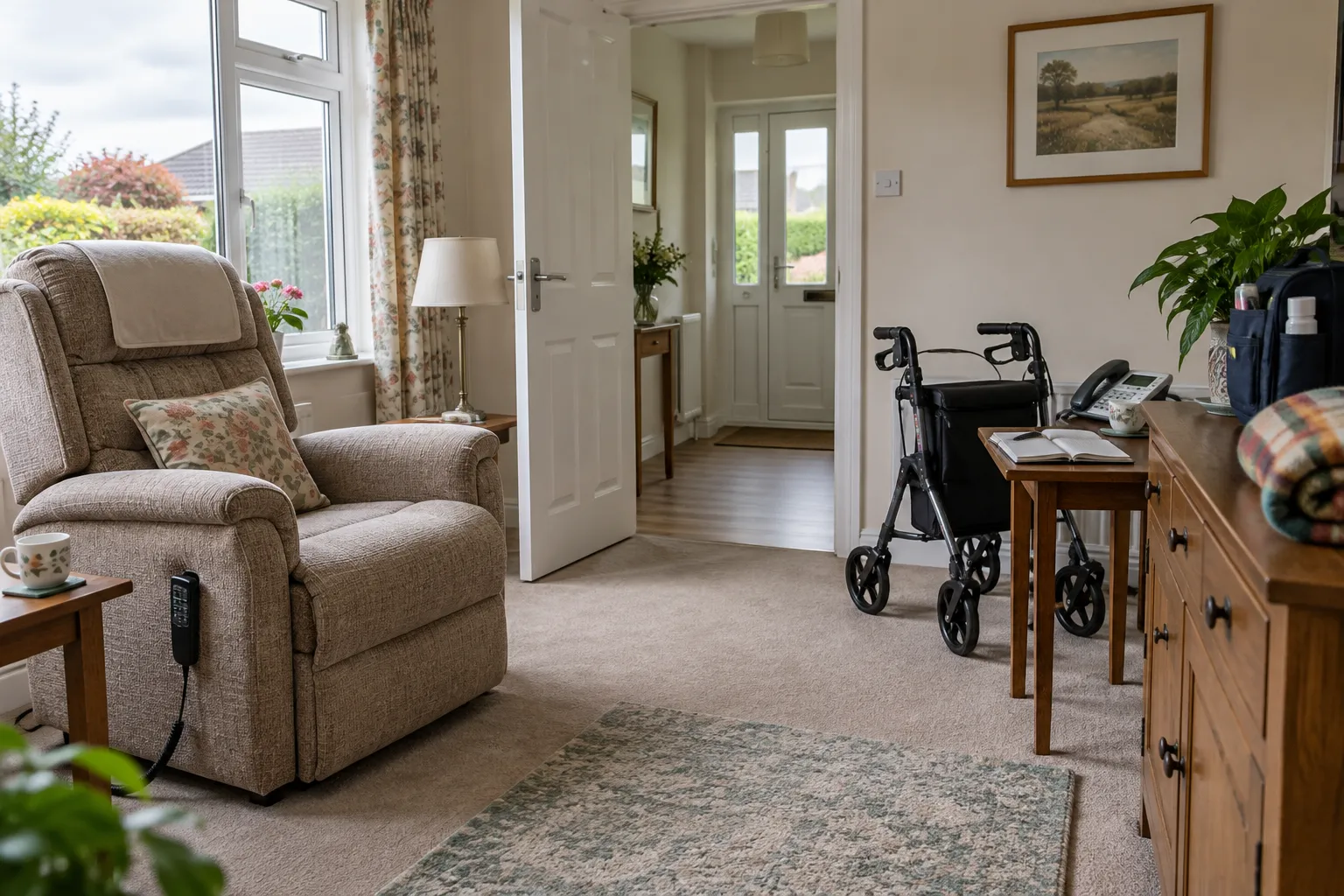
Wheelchairs, walking aids, transfer equipment and supportive seating should not be treated as interchangeable household objects. Some contain upholstery, enclosed joints, electronics, batteries or materials with specific temperature limits. Tell the assessor which items remain in the property and which must accompany the resident. An aid needed for safe movement cannot simply be left behind because it is inconvenient to assess. Equally, an item should not be assumed suitable for heat treatment without checking the relevant manufacturer’s guidance and the technician’s plan.
Make a short equipment list with model details where available, including chargers and removable accessories. Ask the supplier or manufacturer about environmental limits if the instructions are unclear, and share that information with the treatment company. Essential medical equipment requires particular care: its suitability for remaining in a heated environment should not be guessed. Questions involving safe operation, storage or interruption of use belong with the relevant supplier or care professional, alongside the treatment company’s assessment of the property and its contents.
Agree a specific approach for any aid that must leave and later return. That may involve inspection and an item-specific management plan, depending on its construction and the evidence found. Do not spray equipment, steam electrical parts or wrap a device in a way that obstructs its safe operation. The aim is to address a possible route for bed bugs without compromising the equipment’s purpose. If no suitable arrangement has yet been identified, keep that issue open rather than assuming ordinary bagging will solve it.
5. Arrange somewhere genuinely suitable to wait
Being able to leave the property is only half the problem; the resident also needs somewhere suitable to spend the period of exclusion. Check practical features such as step-free entry, toilet access, seating, room for a wheelchair and whether an accompanying person can remain throughout. A café or a relative’s spare room may not meet those needs. Ask the treatment company for the likely absence window and what could extend it, while recognising that safe re-entry cannot be promised for a fixed minute.
Plan the journey in both directions before booking transport. Allow for assistance getting out of the property, time to secure a wheelchair if relevant and any limits on how long the resident can comfortably wait for collection. Discuss these requirements with the transport provider without expecting the treatment technician to supply lifting or transfer assistance. If the return journey depends on a confirmed re-entry call, explain that dependency early and find out how much flexibility the transport arrangement can reasonably offer.
Prepare a fallback if the home is not ready when first expected. This could mean arranging a longer stay at the chosen location or identifying a second suitable option, rather than leaving someone waiting outside. Take only belongings that are needed, following an agreed plan for managing possible bed bug transfer. If a mobility aid or support item cannot be readily managed, raise this before using another property as a waiting place so the assessor can discuss the practical implications with you.
6. Divide preparation into safe, manageable tasks
Ask for a property-specific preparation list that identifies who is expected to do each task. Generic instructions to move furniture, clear floors or remove bedding may be unrealistic for someone with restricted mobility. Explain what the resident can do comfortably and what requires assistance. The company should clarify which tasks its staff undertake and which need to be completed beforehand. Do not assume technicians provide heavy lifting, personal care or household clearance unless those services have been explicitly discussed and agreed.
Keep familiar movement routes usable while preparation is under way. Bags, boxes and temporarily displaced furniture can create problems even before treatment begins. Avoid putting supplies beside a transfer point, blocking access to a toilet or narrowing a route used by a walking frame. If furniture needs to move for treatment access, ask when that should happen and who will do it. Preparation should not leave the resident negotiating a changed layout for days without the support needed to use it safely.
Break the work into shorter sessions if that better suits the household, and arrange help before fatigue or time pressure becomes a problem. Label belongings by destination or handling instruction rather than repeatedly sorting them. Avoid unnecessary disposal, especially of specialist furniture that would be difficult to replace. Bed bugs do not automatically mean a bed, chair or mobility aid must be thrown away. Ask for an assessment of the item and a clear explanation of available options before making a disruptive decision.
For a property-specific assessment, see our bed bug heat treatment in Dorset. Share your postcode and property details so the team can confirm coverage and availability.
7. Keep essential belongings available without improvising
Make an essentials list for the period away from home, covering communication aids, spectacles, hearing aid accessories, appropriate clothing, chargers and any personal care supplies the resident normally needs. Include items that an accompanying carer will use, rather than assuming they will already be in a separate bag. Review the list with the treatment company so there is a clear distinction between belongings remaining for treatment and those leaving under an agreed handling plan. Keep that plan simple enough for everyone involved to follow.
Ask a pharmacist, equipment supplier or usual care professional about storage requirements for medicines and health-related supplies where necessary. Do not assume an insulated bag, refrigerator or cupboard inside the property will protect contents adequately during heat treatment. Pest control staff should not advise changes to medication or clinical routines. Their role is to explain the treatment environment and restrictions, allowing the appropriate professional to advise on the items for which they are responsible and the household to make suitable arrangements.
Once essential items have been managed as instructed, keep them separate from belongings whose status is uncertain. Avoid opening prepared bags on upholstered furniture simply to check the contents again. A written checklist can reduce repeated unpacking, particularly when several people are helping. However, containment must never prevent access to something needed for safe communication, movement or care. Where those priorities conflict, ask for an item-specific solution rather than applying a blanket rule that everything must remain sealed throughout the day.
8. Confirm responsibilities before the treatment appointment
Before the appointment, confirm who will meet the technicians, who will support the resident’s departure and who can authorise decisions about the property. These may be different people. Provide a reliable contact number and an alternative in case the main contact becomes unavailable. Explain any communication requirements, such as needing information in writing or extra time to understand a change. Important arrangements should not depend on a hurried conversation at the doorway while transport is waiting and carers are finishing their visit.
Bed Bug Heat Control UK provides 100% chemical-free heat treatment at 60–65°C. That does not mean residents can stay inside the treatment area or return before the team gives clearance. Ask how the company manages access restrictions, checks treatment progress and decides when the property can be reoccupied. The assessor should also explain how the proposed scope relates to the evidence found and the building’s layout. Essential access or care requirements must be resolved within that plan, not handled through unplanned entry during heating.
Ask what happens if the appointment cannot proceed as planned. Transport could fail, a necessary support person could be unavailable or the household’s circumstances could change. Clarify who to call and how the company handles rescheduling, without assuming particular terms. Bed Bug Heat Control UK is fully insured and uses discreet unmarked vans, but practical questions about equipment handling and responsibilities still deserve explicit answers. Having these conversations early helps everyone understand the service being provided and where additional assistance needs to come from.
Related practical reading: Heat-sensitive belongings: questions to ask before treatment
9. Plan a supported return to the home
Wait for explicit clearance from the treatment team before arranging entry. A projected finish time is not itself permission to return, and the fact that equipment has been switched off does not establish that the home is ready. Ask who will make the re-entry call and what information will be provided. If the resident needs assistance on arrival, coordinate that support with the clearance process so there is no gap between arriving at the property and being able to enter and settle safely.
Before the resident resumes their usual routine, have an agreed person check that necessary routes, seating and everyday items are accessible. Treatment work may have involved moving furniture or changing the position of belongings. Confirm whether reinstatement is included or needs separate help. Check that essential equipment can be used in accordance with its normal instructions, involving the relevant supplier if there is any uncertainty. Do not assume that a room looking tidy means every transfer point or frequently used control is back in its familiar position.
Resume care visits using the arrangements agreed with the provider, and pass on any relevant aftercare instructions. Keep the first period at home straightforward rather than immediately unpacking every bag or rearranging multiple rooms. The treatment team should explain what to do with managed belongings and any observations worth reporting. If something essential is missing, inaccessible or not working normally, address that practical issue through the appropriate contact rather than trying to adapt unfamiliar equipment or manage without necessary support.
10. Keep one clear record for follow-up
Retain a concise record of the assessment, agreed treatment scope, equipment decisions, preparation instructions and follow-up contact details. A shared written plan can be particularly useful where several relatives or carers support the same person. Keep it somewhere appropriate and accessible to those who need it, with the resident’s permission. Distinguish the company’s instructions from informal suggestions so that later helpers do not unknowingly reverse an agreed arrangement or introduce unnecessary cleaning, disposal or movement of belongings between rooms.
Bed Bug Heat Control UK offers a 3-month written guarantee. Ask for the terms and read them alongside the agreed treatment scope, including how to report concerns and what follow-up arrangements apply. A guarantee should not be interpreted as protection against every possible future introduction of bed bugs. If new evidence appears, record what was seen and contact the company for assessment rather than immediately repeating preparation or discarding specialist items. Coordinated follow-up is usually more useful than several helpers taking separate, unplanned actions.
The central principle is to plan around the person as well as the pest problem. Accessible transport, suitable temporary accommodation, reliable care and workable equipment arrangements are not minor extras; they determine whether the appointment is practical. Start with a professional assessment and make unresolved dependencies visible before committing to a date. To discuss a property assessment with Bed Bug Heat Control UK, call 0800 274 0156. The team is open 7am–10pm daily, giving households and their supporters time to raise questions before arranging treatment.
Sources & further guidance
General information, not a diagnosis, medical advice or legal advice. Research and US EPA references provide technical background, not UK law, and do not endorse our company. Your property assessment and the team’s written preparation instructions take priority.