When bed bugs are suspected in a property that will soon be empty, waiting can seem like the simplest solution. Perhaps you are staying elsewhere, leaving a second home unused or dealing with a house between periods of occupation. Without anyone sleeping there, surely the insects will disappear? Unfortunately, absence is not a dependable treatment. Bed bugs can survive without feeding for extended periods, and a quiet property offers few opportunities to notice them. This guide explains what vacancy does and does not change, why there is no reliable household countdown to safety, and how to organise a proportionate professional response before the property is occupied again.
1. An empty property is not the same as a cleared property
Bed bugs depend on blood meals, but they do not need to feed every day to remain a problem. When occupants leave, the immediate opportunity to feed may disappear while insects remain sheltered in the property. Their survival depends on several interacting conditions, including temperature, life stage and when they last fed. This makes vacancy a change in circumstances rather than a reliable method of control. Closing the door does not establish whether any insects were present, where they were hiding or whether they have died.
It is useful to separate three descriptions that are often treated as interchangeable: unoccupied, quiet and professionally treated. Unoccupied simply means nobody is living or sleeping there. Quiet means there has been little or no recent observable activity. Professionally treated means a defined intervention has taken place, with its own scope and follow-up arrangements. Only the last description tells you that a control measure has actually been carried out, and its outcome still needs to be considered in the context of the property.
This distinction matters whether a house is empty for a fortnight or left unused for much longer. A gap in occupation should not automatically be described to returning occupants as evidence that a previous concern has resolved. Equally, an empty house is not automatically infested merely because somebody once reported unexplained marks on their skin. The sensible starting point is to establish what evidence exists, what remains uncertain and whether a professional property assessment is needed before making decisions about future use.
2. Why there is no dependable waiting period
People understandably want a straightforward answer to the question, “How long can bed bugs survive in an empty house?” The difficulty is that a survival period observed under particular conditions cannot be turned into a guaranteed household deadline. Bed bugs at different stages do not all have the same reserves, and an actual home does not maintain one perfectly controlled temperature. A room near a sunny window, an insulated internal space and a cooler recess may each provide a different environment over time.
Temperature is particularly important because bed bugs are affected by their surroundings. Cooler conditions can slow their activity and extend survival without feeding, although the relationship is not a simple rule that can be applied from a thermostat reading. A colder-looking property is therefore not necessarily becoming safe more quickly. Nor does ordinary warmth prove that insects will soon exhaust themselves. Professional assessment considers the situation as a whole rather than using the weather, season or heating schedule as a substitute for evidence.
A more useful question is, “What would give us a reasonable basis for deciding this property can be used again?” That shifts the discussion away from an unreliable countdown and towards assessment, any necessary treatment and agreed next steps. Avoid setting a return date solely because a suggested number of weeks has passed. If bed bugs were confirmed before the home became empty, make that history clear when seeking advice, even if nobody has seen further activity during the intervening period.
3. The absence of bites provides little information in an empty home
In an occupied home, residents may first raise a concern after noticing skin marks, although those marks alone cannot confirm bed bugs. Once nobody is sleeping in the property, that source of information disappears altogether. There are no occupants to notice possible overnight exposure, and there may be nobody checking the same surroundings regularly. A silent period can therefore reflect a lack of observation rather than a genuine improvement. It is important not to confuse missing information with reassuring evidence.
Occasional daytime visits do not recreate normal occupation. Someone collecting post or checking the boiler might see nothing unusual, even where a bed bug problem remains unresolved. The insects are small, often concealed and not obliged to emerge during a brief visit. Conversely, finding an old mark or a previously shed skin does not, by itself, show that live insects remain today. Existing signs need context, particularly if the rooms have been left undisturbed since an earlier concern or treatment.
When discussing a vacant property with a professional, describe the observation gap plainly. Explain when someone last slept there, whether insects were positively identified and whether any treatment occurred before it became empty. Do not feel obliged to fill the gaps with assumptions. “Nobody has checked regularly” is more useful than “there have been no bed bugs for months” when that conclusion rests only on the absence of residents. Clear distinctions between what was seen and what was inferred support better decisions.
Continue the topic: Bed bug heat treatment versus sprays: making an informed choice
4. Leaving one bedroom unused does not isolate a problem
The same reasoning applies on a smaller scale when a spare bedroom or guest room is closed after a concern. An unused room remains part of the home rather than becoming a sealed treatment chamber. Bed bugs may remain in harbourages, and movement within a property is possible. Whether that happens depends on the layout and circumstances; it should not be assumed that every room is affected. However, simply shutting a bedroom door is not a reliable way to define or eliminate the problem.
Changing sleeping arrangements can also complicate the picture. It is understandable to want distance from a room associated with bed bugs, but taking bedding or other belongings elsewhere may introduce additional questions about where items have been. This does not mean anyone should be instructed to endure a distressing situation without support. It means a professional should help assess the implications before a change of room is treated as the solution. Advice should reflect the actual evidence and the needs of the household.
Tell the assessor about occasional sleeping spaces as well as the room where the original concern arose. A sofa used overnight, a guest bedroom occupied at weekends or a room used by a visiting relative can be relevant to understanding the property. There is no need to assume that all these areas require treatment simply because they exist. The purpose is to avoid presenting an incomplete history in which the home is described as empty when some rooms have continued to be used.
5. Why normal heating, winter cold and sunshine are not substitutes
An empty house may offer the temptation to turn up the heating and leave the building closed. Ordinary central heating, however, is designed for comfort rather than pest eradication. A thermostat reading cannot demonstrate that concealed harbourages have reached an effective treatment temperature. Air, furniture and protected spaces can warm at different rates, and apparently hot rooms may still contain cooler areas. Leaving the heating running should not be regarded as equivalent to a professionally planned and monitored bed bug heat treatment.
The opposite approach is equally unreliable: turning off the heating and expecting winter conditions to clear the house. Outdoor temperature does not describe every sheltered space indoors, and fluctuating cold is not a controlled treatment. Sunshine through closed windows is another source of uneven warming rather than verified control. These approaches can also distract from ordinary property-care responsibilities. Do not alter a building’s environmental conditions as an improvised pest-control experiment or assume that weather exposure provides evidence that an infestation has ended.
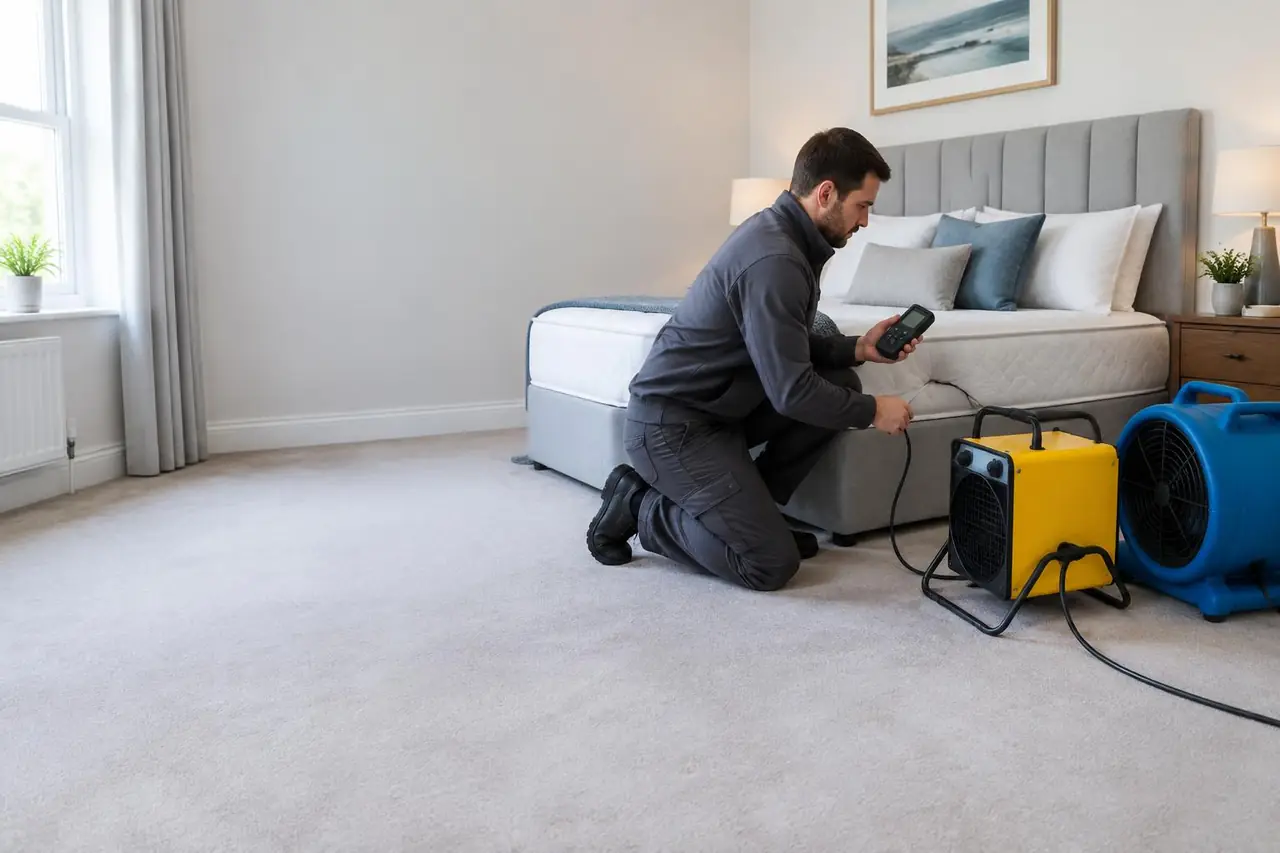
Bed Bug Heat Control UK provides 100% chemical-free heat treatment at 60–65°C. That is a professional service, not a target for residents to reproduce with domestic heaters. The treatment plan, equipment placement and assessment of how heat moves through the relevant spaces all matter. If a property has already been left unusually hot or cold in an attempt to deal with bed bugs, explain this when requesting an assessment. It is background information, not proof that treatment has succeeded.
6. Give the assessor a clear history of the vacancy
A useful property history starts with a simple sequence of events. Record when the concern first arose, what was actually found, when the property stopped being regularly occupied and whether anyone has stayed there since. Include any previous pest-control work and the information supplied by the provider, if available. This is not about creating an elaborate dossier. A short, factual account can prevent the assessor from having to reconstruct important details from uncertain memories or assumptions about how the home has been used.
Changes to the contents also deserve a mention. Explain whether beds, upholstered furniture or stored belongings have remained in place, been removed or been brought in during the vacancy. Emptying a room does not automatically resolve an infestation, because potential harbourages are not restricted to the most obvious furniture. Equally, furniture remaining in the house does not establish that it is infested. The assessor needs the history so that any recommendation reflects the property as it now stands rather than an earlier arrangement.
Be equally clear about the limits of any previous identification. There is a meaningful difference between an insect confirmed as a bed bug, an unclear photograph and a suspicion based only on skin marks. A professional can advise what further assessment is appropriate without treating each of these starting points as equivalent. Readers in Leicestershire can request a property assessment. Wherever the home is located, ask whether the proposed assessment can address both the original evidence and any changes that occurred while it was empty.
For a property-specific assessment, see our bed bug heat treatment in Leicestershire. Share your postcode and property details so the team can confirm coverage and availability.
7. Plan access before fixing the next occupation date
An empty home can sometimes make scheduling simpler because there are fewer daily activities to work around. It can also introduce practical obstacles: the person arranging treatment may live elsewhere, keys may be held by another contact, and access may be available only at limited times. Resolve those details early rather than assuming vacancy means the property is ready. A professional still needs a clear understanding of the premises and an agreed route for assessing and, where appropriate, treating the relevant areas.
If someone is due to return, explain that date at the first enquiry. An intended arrival provides a planning constraint, not evidence that the home will be ready by then. Assessment may identify questions that need resolving before a treatment can be booked or carried out. Avoid promising future occupants that a property is cleared solely because an appointment has been requested. It is more accurate to distinguish between an enquiry, a confirmed booking, completed treatment and whatever follow-up arrangements have been agreed.
Choose one person to coordinate practical information wherever possible. That person can pass on the vacancy history, confirm who holds the keys and make sure questions reach the technician rather than becoming lost between several contacts. This is particularly helpful when relatives are looking after an unused home from a distance. It does not require anyone to take on technical responsibilities themselves. The aim is simply to ensure that the person arranging the work and the person providing access are working from the same information.
8. Vacant properties still need the official preparation checklist
A house without residents is not necessarily a house that is ready for heat treatment. Furniture, stored possessions, electronics and alarm systems still need to be considered. For Bed Bug Heat Control UK appointments, the official checklist at /bed-bug-heat-treatment-preparation is the one list to follow. Do not substitute a general internet guide or assume that instructions for an occupied home no longer apply. If the property is largely empty, ask the technicians how the checklist applies to the items and systems that remain.
The checklist requires all electronics to be removed from treated rooms, along with loose papers; once booked, books should be removed and stored in sealed plastic boxes. It also specifies which heat-sensitive items must be moved from bedrooms and the lounge to the kitchen. Mattresses without bedding, emptied beds, dismantled wooden frame parts and the listed furniture stay in the room. These are selective instructions, not a request to strip out everything. Follow the full checklist rather than treating this summary as a replacement.
Safety arrangements remain important even when nobody is living at the address. The checklist covers sprinklers and the isolation, disabling or covering of specified alarm systems throughout the treatment zone; arrange these requirements with the technicians and appropriate responsible people rather than improvising. It also requires nearby parking, a key handover or meeting time, and a treatment window of 4–6 hours. Ask before treatment if you are unsure whether any item can stay. The official checklist remains the single reference for all preparation.
Related practical reading: How professional bed bug heat treatment works
9. Keep completion, re-entry and the guarantee clearly documented
When the person booking treatment is not staying at the property, it is especially useful to agree how completion information will be shared. Ask who will receive the technician’s update and how instructions will reach anyone returning later. Do not infer that a property is ready for entry simply because the booked treatment window has elapsed. Follow the technician’s directions about returning and restoring normal use. A clear handover is more dependable than a message passed through several people who were not present.
Bed Bug Heat Control UK provides a 3-month written guarantee. Ask for the written terms and clarify how they apply if the home will remain unoccupied after treatment. In particular, establish the relevant dates and the process for raising a concern rather than assuming that the guarantee begins only when somebody moves back in. A written guarantee has a defined scope; it should not be interpreted as an indefinite promise or as proof that future introduction of bed bugs cannot occur.
Retain the treatment documentation with the property’s other relevant records so it is easy to find if questions arise. Keep the distinction between the treatment date and the next occupation date visible. If something concerning is discovered on return, contact the provider with the factual history rather than deciding that every old mark represents continuing activity. Equally, do not dismiss a newly found insect because the house has been empty. The provider can advise what information is needed and whether further professional assessment is appropriate.
10. Replace the waiting strategy with a clear decision
The central question is not whether leaving a property empty changes the conditions for bed bugs; it does. The question is whether that change provides dependable control, and vacancy alone does not. Where bed bugs have been confirmed, waiting without a professional plan leaves uncertainty unresolved. Where the evidence has always been ambiguous, assuming an infestation can also lead to unnecessary disruption. In both situations, assessment is the practical bridge between an uncertain history and a decision that fits the actual circumstances.
A straightforward next step is to bring together the original evidence, the vacancy dates and any previous treatment records, then discuss the property with a professional. Explain whether it remains furnished, whether anyone visits overnight and when regular occupation is expected to resume. These details help frame the assessment without pretending to diagnose the home remotely. If treatment is recommended, use the official preparation checklist and agree access, completion communication and follow-up arrangements before relying on the property being ready for someone’s return.
Bed Bug Heat Control UK is fully insured and uses discreet, unmarked vans. To discuss a vacant or occasionally occupied property, call 0800 274 0156 between 7am and 10pm daily. The aim is to replace guesses about survival times with a property-specific assessment and, where needed, professional 100% chemical-free heat treatment. An empty home may look peaceful, but appearances cannot settle a bed bug concern. A clear plan gives returning occupants a sounder basis for their next steps than simply waiting longer.
Sources & further guidance
General information, not a diagnosis, medical advice or legal advice. Research and US EPA references provide technical background, not UK law, and do not endorse our company. Your property assessment and the team’s written preparation instructions take priority.