Bed bug heat treatment versus sprays: making an informed choice Choosing between professional heat treatment and insecticide sprays is not simply a choice between a stronger and a weaker option. A useful comparison starts with what has been found, where the suspected infestation extends, what the property can accommodate and how the proposed treatment will be checked afterwards. Heat and sprays work differently, and neither should be presented as an unconditional promise. Resistance can affect insecticide performance, but that does not mean every spray treatment fails. Professional heat requires careful assessment and monitoring, and it leaves no residual protection against bed bugs introduced later. This guide helps UK households compare proposals, ask about limitations and understand what they are agreeing to, without turning the decision into a technical experiment at home.
1. Establish what needs treating before choosing a method
Before comparing treatment methods, ask what evidence supports the identification and the proposed treatment area. Bites alone cannot identify bed bugs. The NHS notes that bites can be grouped, but skin marks do not establish which pest, if any, is responsible. A treatment recommendation should explain its basis rather than rely solely on a description of itching.
The assessment also needs to look beyond the mattress. NHS information identifies hiding places including bedframes, clothing, pictures and loose wallpaper. For this decision, the important question is not how to inspect every object yourself, but whether the professional has considered the places that could affect treatment scope.
Ask: 'What have you identified, which areas need attention, and what remains uncertain?' If confirmation or access is incomplete, request an explanation of how that changes the proposal. A confident recommendation can still acknowledge uncertainty. Conversely, choosing a method before establishing the likely extent of the problem makes it harder to judge whether the quoted work is appropriate, regardless of how persuasive the advertised benefits sound.
2. Compare the proposed coverage, not just heat against spray
The labels 'heat treatment' and 'spray treatment' tell you less than a written description of the work. Two proposals may cover different rooms, include different checks or assume different household preparation. Before weighing the methods, establish whether you are comparing plans for the same problem and the same treatment area.
For heat, ask which spaces and belongings are included and how the professional will assess whether the treatment has reached the intended areas. For sprays, ask which product and application approach are proposed, what areas will receive treatment and what follow-up is planned. You do not need instructions for applying either method yourself.
Request a clear explanation of exclusions, inaccessible areas and any circumstances that could require additional work. A limited treatment is not automatically unsuitable, but its boundaries should be understandable. If one quotation covers a broader area or includes more follow-up, that difference matters alongside the method. Compare the purpose and scope of each proposal before treating their headline descriptions as interchangeable alternatives for your home.
3. Discuss insecticide resistance without dismissing all sprays
Resistance is a legitimate consideration when discussing bed bug insecticides, but it should not become a blanket statement that sprays never work. Equally, the fact that a product is intended for bed bugs does not establish that it will resolve every infestation. Ask how the professional accounts for possible resistance in the proposed plan.
An unsuccessful previous spray treatment does not, by itself, prove resistance. The assessment should also consider identification, coverage, access and the possibility of bugs being introduced again. Tell the assessor what was used previously, where it was applied and when, using packaging or treatment records if available rather than guessing product names.
A useful question is: 'If activity continues, how will you investigate the reason and decide what to change?' Look for an explanation that allows for several possibilities, not an automatic diagnosis of resistance or household error. Avoid adding more products while waiting for advice. Uncoordinated applications make the treatment history harder to interpret and are not a substitute for reviewing the original plan with the professional.
Continue the topic: How professional bed bug heat treatment works
4. Judge heat by professional control, not a temperature claim alone
Heat treatment should be assessed as a controlled professional process, not as a promise that making a room hot will solve the problem. The EPA supports professionally monitored heat and warns that household heating is unreliable for this purpose. These are US technical references, not statements of UK law or local regulatory requirements.
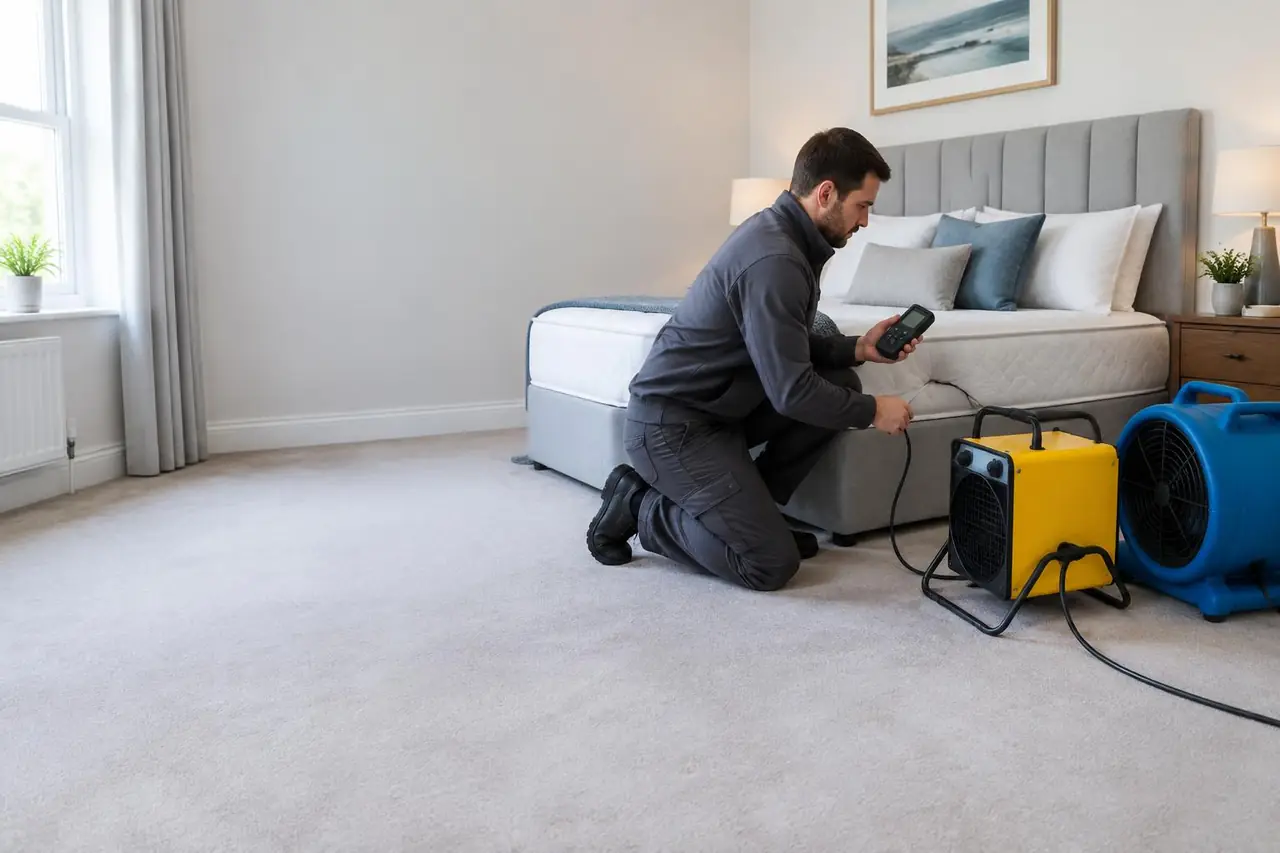
Bed Bug Heat Control UK describes its service as chemical-free controlled professional heat at 60–65°C. When discussing that service, ask how property assessment, equipment positioning and monitoring inform the plan. The advertised temperature is useful information, but it does not replace an explanation of how the intended treatment area will be managed.
Ask what could limit treatment coverage and what happens if the property cannot be treated as initially expected. Professional heat should not be described as incapable of failure. Nor should a household attempt to recreate it with space heaters or improvised heating arrangements. The decision is whether the proposed professional process suits the property, with its limitations explained, rather than whether a household can reach a headline temperature.
5. Understand exactly what heat leaves behind: no residual prevention
A central distinction is that heat does not leave a residual insecticide behind. That can matter to households seeking a chemical-free treatment, but it also means heat provides no continuing chemical barrier against bed bugs introduced afterwards. Successful treatment and future prevention are separate questions, and a proposal should not blur them.
For a spray proposal, ask whether any residual action is expected from the particular product and application. Do not assume that every spray has the same effect or that a residual treatment guarantees protection against later introductions. The professional should explain the intended role and limitations of the proposed product in plain language.
This distinction is especially important when comparing guarantees. A written guarantee is a service commitment with stated terms; it is not evidence that heat continues working after the process ends. Ask how the provider distinguishes continuing activity from a suspected new introduction and what support follows either report. Choose with a realistic understanding of aftercare rather than paying for an implied protective effect that the method does not provide.
6. Match household needs to the actual treatment requirements
Children, pets, household routines and belongings all belong in the initial discussion, but they do not automatically determine the right method. Chemical-free heat may be attractive to some households. That preference still needs to be considered alongside property suitability, heat-sensitive items and the practical requirements of the planned professional treatment visit.
For a spray proposal, request clear household instructions specific to the planned products and application, including access and return arrangements. For heat, request the corresponding instructions about occupancy, belongings and any items needing special consideration. Do not assume that 'chemical-free' means there are no preparation requirements or that all belongings can remain unchanged.
Explain practical constraints early: who needs access, whether temporary arrangements are difficult and which items raise concerns. Ask the provider to identify any issue that could change the method, scope or timing before you commit. This is a suitability conversation, not a request for clinical reassurance. If instructions cannot be followed, say so; an unresolved practical problem is more useful to identify before treatment than on the day.
For a property-specific assessment, see our bed bug heat treatment in Greater Manchester. Share your postcode and property details so the team can confirm coverage and availability.
7. Compare the full programme, not just the treatment day
Speed matters when a bed bug concern is disrupting daily life, but distinguish the length of a treatment visit from the wider process. Assessment, preparation, access arrangements and subsequent checks all affect the household experience. A short headline timescale does not tell you what happens if evidence of activity is reported afterwards.
Bed Bug Heat Control UK offers a single-day process subject to property assessment. Treat that qualification as part of the offer, not small print to overlook. Ask whether your property is suitable and what remains to be confirmed. For a spray option, ask about the proposed visit schedule without assuming every insecticide programme follows the same timetable.
Obtain a property-specific quotation and compare what it includes: assessment, treatment area, planned visits and responses to continuing activity. Do not infer a universal price advantage for either method. A proposal becomes easier to evaluate when you can see both the immediate commitment and the possible next steps. Also confirm whether the conversation is an enquiry or an actual booking before making household arrangements.
8. Ask whether the recommendation is heat, sprays or a coordinated plan
A balanced assessment need not force every property into an either-or answer. Ask whether the professional recommends heat alone, an insecticide approach or a coordinated plan, and why. Any recommendation should follow the identified problem and property constraints rather than assume that adding methods always produces a better result for the household.
If more than one method is proposed, clarify who is responsible for each part and how the household instructions fit together. A combined plan should be described accurately: treatment involving insecticide is not wholly chemical-free. Equally, a chemical-free heat service should not be assumed to include sprays unless the provider explicitly says so.
Avoid supplementing a professional plan with improvised heating or unagreed pesticide applications. The EPA describes bed bug control as complex and emphasises care and containment. Cleaning alone cannot guarantee removal either. Your role is to communicate previous actions and practical concerns, then obtain one understandable plan. If two providers are involved, ask them to clarify responsibilities rather than leaving the household to reconcile potentially conflicting advice on its own.
Related practical reading: Chemical-free heat treatment for households with children and pets
9. Test follow-up promises and guarantee wording before agreeing
Ask each provider how they want possible continuing activity reported and what information helps them decide the next step. The answer should connect observations to assessment, not promise that every later skin mark proves treatment failure. Because bites alone cannot identify bed bugs, follow-up decisions need more care than that simple shortcut.
Bed Bug Heat Control UK offers a three-month written guarantee, with full coverage and conditions explained before booking. Request that explanation while comparing options. Ask what is covered, what circumstances affect coverage and what response the guarantee provides. Do not assume that the word 'guarantee' means the same service commitment in every quotation.
Keep the written scope, household instructions and guarantee together so everyone involved can refer to the same information. Check who should be contacted if concerns arise and whether any proposed additional work falls within the agreed arrangement. This makes follow-up a defined part of the purchase rather than a vague reassurance. It also separates the provider's contractual promise from claims about what heat or sprays can physically achieve.
10. Take a short decision brief into your service enquiry
Before contacting a provider, write down the evidence available, rooms of concern, previous treatments and household constraints. Then ask for a recommendation that explains identification, scope, method, limitations and follow-up. You should be able to describe why the proposed option fits your property without relying on slogans such as 'sprays never work' or 'heat cannot fail'.
For a Greater Manchester service enquiry, Bed Bug Heat Control UK can be contacted on 0800 274 0156 or at info@bedbugheatcontroluk.co.uk, from 7am–10pm Monday–Sunday. The business states 40 years in the industry, is fully insured and uses unmarked vans. These details may inform your choice, but they do not replace a property-specific assessment.
Make the next step a request for the written proposal, property-specific quotation and guarantee conditions, not an assumption that your enquiry has booked treatment. Resolve any uncertainty about access, exclusions or household requirements before agreeing. Choose the plan whose reasoning and responsibilities are clear, and make sure everyone in the home understands the agreed instructions rather than starting separate remedies while arrangements are being finalised.
Sources & further guidance
General information, not a diagnosis, medical advice or legal advice. Research and US EPA references provide technical background, not UK law, and do not endorse our company. Your property assessment and the team’s written preparation instructions take priority.