Choosing a bed bug treatment company can feel difficult when you want the problem resolved quickly but do not yet know what a suitable service should include. A confident telephone manner or a short list of promises is not enough to explain whether a proposal fits your property. The most useful comparison looks at assessment, treatment scope, safety planning, written terms and follow-up together. This guide explains what to ask before booking, how to recognise answers that need clarification and which details to keep in writing. The aim is not to make you an expert in pest control, but to help you make a calm, informed decision with professional support.
1. Start with a clear account of the problem
Before comparing companies, prepare a short description of what has prompted your concern. Note which rooms are involved, when you first noticed possible signs and whether you have photographs or a specimen available for identification. Separate direct observations from assumptions: finding an unidentified insect is different from having a confirmed bed bug identification. A responsible provider should be interested in that distinction. It helps them decide what assessment is appropriate rather than moving straight from your first enquiry to a treatment recommendation.
Include practical information about the property, such as its layout, the number of occupied bedrooms and any spaces that may be difficult to access. Explain whether anyone has already used insecticides, moved beds or discarded furniture. These details are not reasons to feel embarrassed; they can affect the next steps and the interpretation of evidence. You do not need to dismantle rooms to produce a perfect report. Offer what you know and let the professional explain what further information they need.
When you contact several providers, give each one the same core information. Otherwise, apparently different proposals may simply reflect different descriptions of the situation. Keep your notes nearby during calls and record any additional questions each company asks. Thoughtful questions about evidence, layout and previous actions can be more informative than an immediate promise. If the identification remains uncertain, ask how that uncertainty will be resolved before you commit to treatment, and whether assessment is a separate stage of the service.
2. Ask how assessment leads to a recommendation
A treatment recommendation should have a clear basis. Ask whether the company assesses photographs initially, carries out an on-site inspection or uses a combination of approaches. Photographs may help with identification, but they cannot reveal every access issue or establish the full extent of activity within a property. The provider should explain the limits of its initial advice. If a booking is proposed before a visit, ask which assumptions underpin it and what happens if the property assessment changes the plan.
Useful assessment questions go beyond asking whether bed bugs are present. Ask how the provider considers neighbouring rooms, connected spaces and evidence outside the main sleeping area when deciding treatment scope. This is not a request for a guarantee that every hiding place can be seen. It is a way to understand whether the company is considering the property as a whole. A recommendation should distinguish between confirmed findings, areas that need further examination and sensible precautions based on the circumstances.
Be cautious about advice that treats every enquiry as identical or declares the extent of a problem from symptoms alone. There may be good reasons for a provider to offer an initial outline remotely, but uncertainty should remain visible rather than disappear behind confident language. Ask what findings would lead to a revised recommendation or a decision not to treat. A company willing to explain those possibilities gives you a clearer basis for consent than one offering a fixed answer regardless of evidence.
3. Compare written scope, not just the headline service
The word treatment can describe quite different packages. Request a written outline identifying which rooms or areas are included, what method is proposed and whether any follow-up visits form part of the agreement. Check whether the proposal covers the assessment itself or assumes that identification has already been established. If two companies describe their services differently, ask them to clarify the boundaries before comparing them. A short headline description may omit the very details that explain why their recommendations are not equivalent.
Ask what could change the scope after arrival. Restricted access, unexpected storage areas or new evidence may require a discussion before work proceeds. You should understand how the provider handles such discoveries, who authorises changes and how any revised charges would be communicated. There is no need to predict every possible complication yourself. The important point is that a process exists for discussing material changes, rather than leaving you to discover afterwards that the service differed from your understanding.
Written quotations should also make practical exclusions visible. For example, a provider may need to explain how inaccessible spaces or belongings removed before treatment affect the proposed work. An exclusion is not automatically a warning sign; unexplained exclusions are more difficult to evaluate. Read the scope alongside any preparation document and guarantee terms, because those documents should tell a consistent story. If one promises comprehensive coverage while another substantially narrows it, request clarification in plain language before accepting the booking.
Continue the topic: Bed bug heat treatment versus sprays: making an informed choice
4. Understand what the treatment description actually means
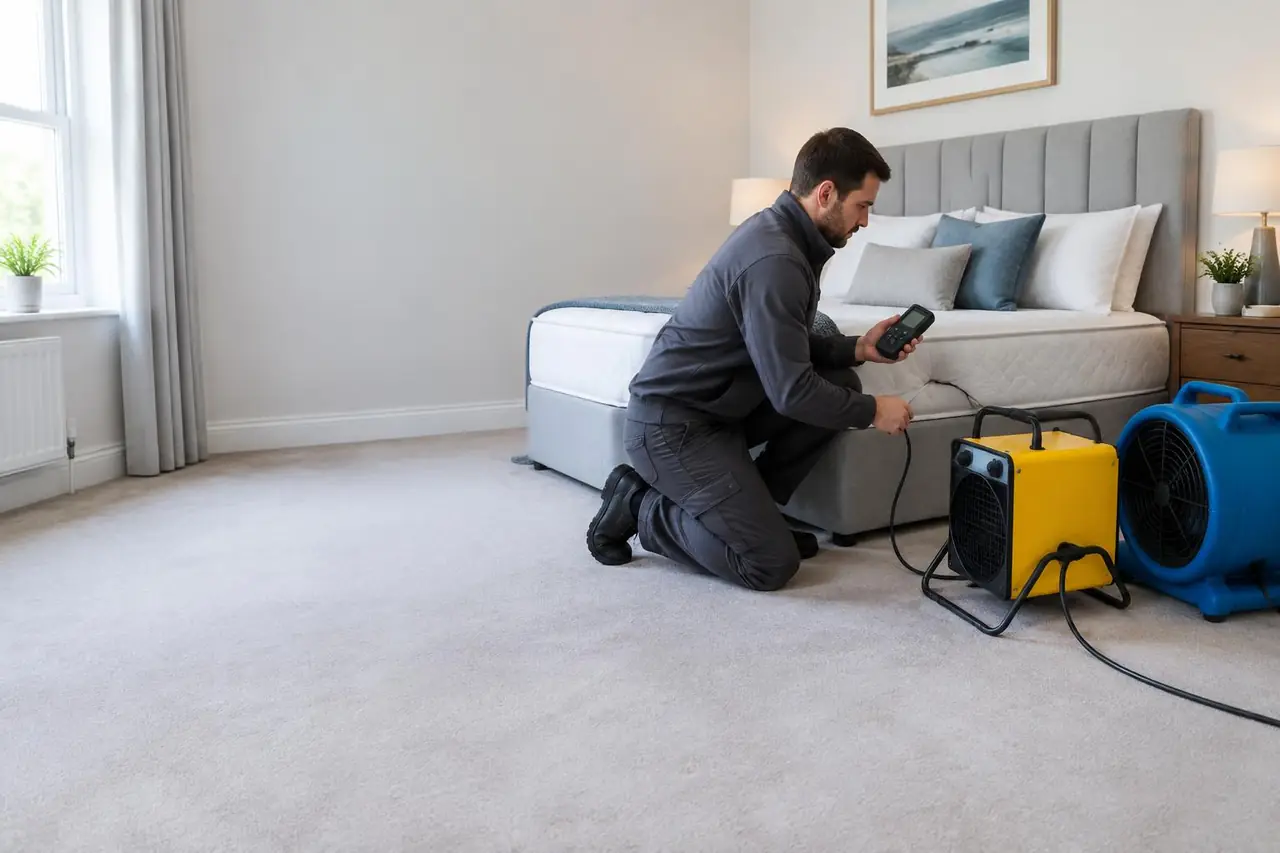
Ask the provider to describe its method without relying solely on labels such as professional, advanced or complete. If heat is proposed, find out how the equipment, temperature monitoring and room arrangement are used to deliver the planned treatment. Heat needs to reach relevant harbourages for a suitable duration; a headline air temperature does not explain that process on its own. You are not expected to evaluate the equipment technically, but the company should be able to explain its approach clearly.
Bed Bug Heat Control UK provides 100% chemical-free heat treatment at 60–65°C. When discussing this service, ask how temperatures are monitored and how the treatment plan accounts for furnishings, room layout and places that may warm more slowly. These questions help put the temperature range into context. Chemical-free describes the treatment method; it does not mean that people, animals or belongings can remain without a safety plan. Any provider should explain occupancy restrictions and property-specific precautions before work begins.
Clarify whether the quoted service includes any additional treatment products or whether the method remains entirely chemical-free. Across the market, similar advertising language may refer to different combinations of methods. If avoiding chemical treatments matters to your household, make that requirement explicit and obtain confirmation in writing. Equally, ask the provider to explain limitations rather than claiming that one phrase settles every concern. A suitable recommendation should connect the method to your assessed circumstances, not merely repeat its most appealing feature.
5. Check responsibility, insurance and professional competence
Know who you are booking with and who will attend your property. Ask for the business name, contact details and confirmation of whether the work is performed by its own team or another contractor. If another organisation is involved, clarify who handles the assessment, treatment, payment and any later concerns. This is about accountability rather than assuming that one staffing arrangement is always better. You should not have to work out which business is responsible only after you need help.
Insurance is another practical subject to raise before booking. Bed Bug Heat Control UK is fully insured, and readers comparing providers should ask for confirmation of insurance appropriate to the work being proposed. Where a particular concern exists, request clarification about the relevant cover rather than assuming that the phrase fully insured answers every question. This is especially useful when a property contains unusual fixtures or valuable contents. Insurance does not replace careful planning, but it is part of assessing a professional service.
Ask what training and experience are relevant to bed bug work and, where applicable, to the specific heat equipment being used. If a company advertises professional memberships or qualifications, it should be able to identify them clearly so you can verify the claim through the appropriate organisation. Avoid treating a badge or a long list of credentials as a substitute for a coherent plan. Competence should also be evident in accurate explanations, realistic boundaries and a willingness to answer ordinary customer questions.
6. Look for a property-specific safety conversation
A credible booking process should include an opportunity to discuss the household and building, not simply send a generic checklist. Tell the company about children, pets and anyone whose circumstances may make leaving the property or completing preparation more difficult. Explain any access restrictions or building requirements that could affect the visit. You do not need to disclose unrelated personal information. Share what is necessary for practical planning and ask the provider to identify any arrangements that must be agreed in advance.
Questions about property protection should receive specific answers or a clear route to further assessment. Ask who reviews concerns about fixtures, appliances and belongings that may require special handling. If the company needs photographs or an advance visit, establish that before the treatment date. Do not accept an unsupported assurance that nothing in any home could be affected by heat. Equally, avoid making your own removal decisions based on a general concern; moving untreated possessions elsewhere can complicate the overall plan.
Clarify how the team establishes that the property can be re-entered and who communicates that decision. Ask what happens if a safety concern is identified before or during work, including whether treatment might be delayed or adjusted. These are reasonable booking questions, not signs that you are being difficult. A provider should be able to explain how instructions will be given and who is available if something is unclear. Clear responsibility is particularly important when several household members are involved.
For a property-specific assessment, see our bed bug heat treatment in Cumbria. Share your postcode and property details so the team can confirm coverage and availability.
7. Read the guarantee before relying on it
A guarantee is useful only when you understand what it promises. Bed Bug Heat Control UK offers a 3-month written guarantee, and the written terms should be reviewed alongside the proposed treatment scope. When comparing any providers, ask when the guarantee begins, which areas it covers and what response is offered if concerns arise during that period. The duration alone is not enough to compare protection. Two guarantees with similar time periods may involve different conditions, reporting requirements and follow-up arrangements.
Ask how the company distinguishes a possible treatment issue from a new introduction of bed bugs and what assessment is used when that distinction is uncertain. No provider can prevent every future exposure simply by treating a property once. That does not make a guarantee meaningless, but it makes the wording important. Request an explanation of any conditions relating to preparation, access or items taken out of treated areas. Avoid guessing how a condition applies to your own household; ask before booking.
Find out what you would actually do if you noticed a suspicious sign later. The terms should make the contact route and next steps understandable, including what evidence may be requested and whether a visit is included under the relevant circumstances. Keep the guarantee somewhere accessible with your booking documents. If a verbal assurance appears broader than the written promise, ask for the difference to be resolved. A clear, bounded commitment is more useful than reassuring language that leaves the practical response undefined.
8. Assess communication, privacy and scheduling
Good communication is part of the service, especially when several decisions must be made before attendance. Ask who your main contact will be and how quickly you should expect a response to preparation or scheduling questions. Opening hours should not be confused with a promise of immediate treatment availability. Bed Bug Heat Control UK is open 7am–10pm daily, allowing time to discuss enquiries around other commitments. Confirm the availability of assessment and treatment appointments directly rather than assuming that every enquiry can be accommodated immediately.
If discretion matters to you, ask what that means in practice. Bed Bug Heat Control UK uses discreet unmarked vans, but no company should imply that a visit can be made completely invisible. Equipment movement and access arrangements may still be noticeable. Discuss any relevant entry instructions and how the team should contact you on arrival. A useful privacy conversation focuses on workable arrangements, without encouraging secrecy where another person needs information to provide access or coordinate a safe response.
Confirm the expected appointment window, how schedule changes are communicated and what happens if either side needs to rearrange. Read cancellation and rescheduling terms before accepting them, especially if you must organise time away from home. Ask whether the expected duration is provisional and what could extend it. This is not about demanding an exact finish time for a variable process. It is about having enough information to make realistic household arrangements and knowing how updates will be provided.
Related practical reading: How professional bed bug heat treatment works
9. Recognise pressure and unsupported promises
A bed bug concern can create a strong urge to accept the first available solution. Give yourself enough space to understand what you are buying, even when prompt action is sensible. Be cautious if a provider discourages all questions, refuses to share terms or insists that an immediate commitment is necessary without explaining why. Genuine scheduling constraints can exist, but they should be described plainly. Urgency should not replace identification, a suitable treatment scope or an opportunity to read the agreement.
Broad claims deserve careful examination. Statements suggesting that reintroduction is impossible, that every property can be treated identically or that a method has no limitations should prompt further questions. Ask what the claim means in operational terms and where it appears in the written agreement. Avoid trying to judge reliability from confidence alone. A measured answer that acknowledges uncertainty may be more credible than an absolute promise, particularly before the company has reviewed the evidence and the practical features of your property.
Reviews and recommendations can help you form questions, but they should not be your only basis for choosing. Look for information about communication, clarity and how concerns were handled, rather than assuming that another household's outcome predicts yours. Check that you are reading about the same business you intend to book. Where public information is limited, do not fill the gaps with assumptions in either direction. Return to the essentials: verifiable business details, relevant competence, a clear proposal and understandable written terms.
10. Make the final decision with a simple comparison
Bring your notes together before choosing a provider. A straightforward comparison can cover the assessment basis, areas included, treatment method, safety discussion, written guarantee and route for follow-up. Mark any unanswered questions rather than treating missing information as a positive or negative by default. Then ask each relevant company for clarification. You do not need an elaborate scoring system. The aim is to see whether the proposal addresses your actual circumstances and whether you understand the commitments on both sides.
Before confirming, keep copies of the quotation, agreed scope, preparation instructions and applicable terms. Check that your contact details, property information and appointment arrangements are correct. If an important adjustment was agreed by telephone, request written confirmation so it is available to both you and the attending team. This small administrative step can prevent avoidable confusion. Choose on the basis of the complete service and your confidence in its clarity, rather than a single headline promise or the pressure to decide quickly.
To discuss your circumstances with Bed Bug Heat Control UK, call 0800 274 0156 between 7am and 10pm daily. Readers in Cumbria can request a property assessment. Explain the evidence you have, any previous actions and the practical questions that matter most to your household. Ask for the proposed scope and the 3-month written guarantee terms before confirming treatment. A professional assessment is the sensible starting point, and a clear conversation should leave you better informed about the next step rather than simply more hurried.
Sources & further guidance
General information, not a diagnosis, medical advice or legal advice. Research and US EPA references provide technical background, not UK law, and do not endorse our company. Your property assessment and the team’s written preparation instructions take priority.