A possible bed bug sighting can make every mark on the bedding feel significant. The most useful first step is not to decide immediately that you have an infestation, but to look carefully and preserve evidence that someone else can assess. This guide explains how to recognise the broad appearance of an adult bed bug, inspect mattress seams without unnecessarily disturbing the room, and take photographs that support identification. It also separates observations from assumptions: grouped bites, a dark mark or an unclear photograph cannot settle the question on their own. For UK households, the aim is a limited, orderly inspection followed by a proportionate decision. You do not need to dismantle the bed, empty every cupboard or begin treatment simply because you have found something unfamiliar.
How to spot bed bugs: a careful home inspection guide
Begin with a clear purpose: you are checking whether there is evidence worth identifying, not trying to prove a suspicion. Choose a time when you can see properly and work without interruption. Tell anyone sharing the room what you intend to inspect, so bedding and belongings are not moved while you are looking.
Keep the inspection local to the bed at first. Have a torch, your phone, a small clear container with a secure lid and something to record observations. These are tools for seeing and documenting, not treating. Avoid bringing in sprays or heating equipment; neither helps establish what an unfamiliar insect actually is.
Set a stopping point before you start: accessible mattress seams and an initial look at the adjoining bedframe. If something needs force, heavy lifting or dismantling, leave it alone. A useful inspection can end with an uncertain finding and a request for identification. It does not have to end with a household diagnosis.
Use adult size as a clue, not a verdict
The NHS describes adult bed bugs as approximately 5mm long. That gives you a useful sense of scale when examining an insect, but it is not a measurement test that confirms identity. Several unfamiliar household insects can appear similarly small, particularly when viewed briefly, in poor light or through a magnified phone image.
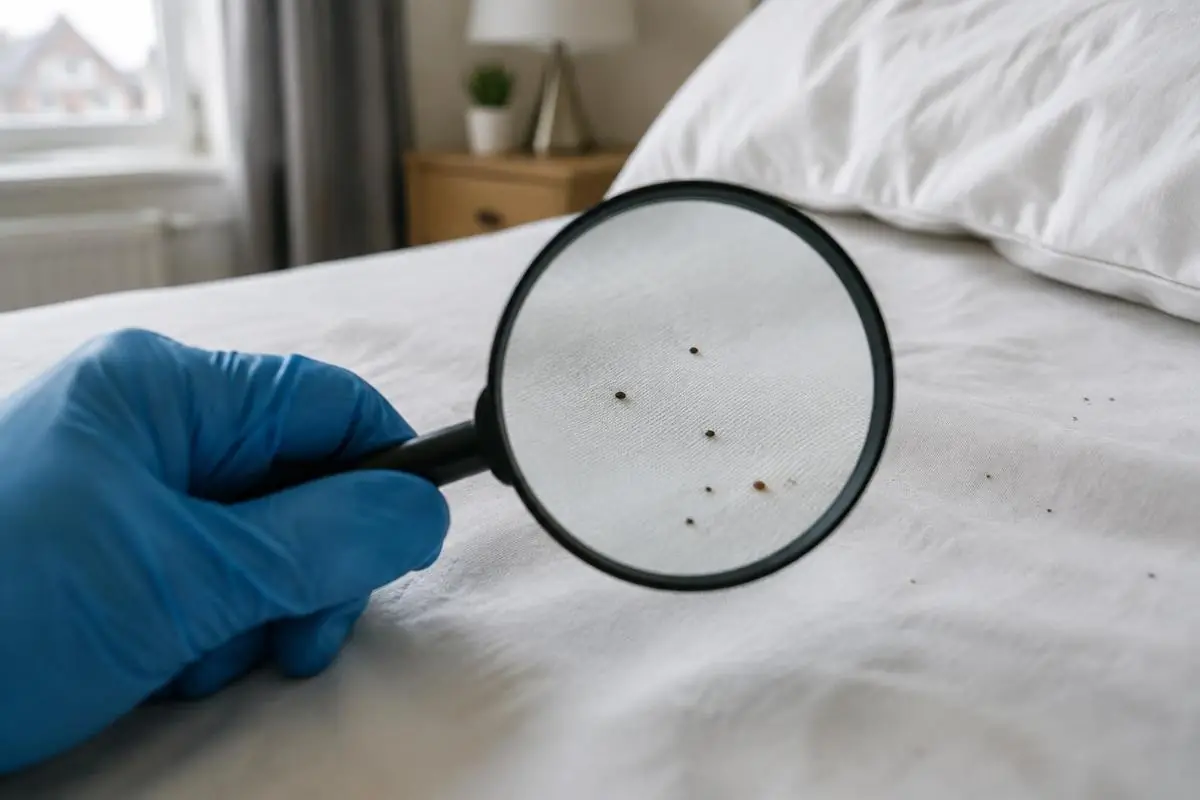
Compare what you actually see with a reliable identification image rather than a remembered description. Look at the whole insect: its outline, body proportions and visible features. Do not decide from colour alone, or from a single feature that seems to match. If those details are not clear, record the appearance as uncertain.
An approximate size is most helpful when supported by an image with scale and a precise location. Write 'small insect beside the mattress seam, approximately 5mm' rather than 'adult bed bug' until identification is supported. Conversely, finding something smaller does not settle what it is. Questions about eggs and immature stages require a more detailed identification approach.
Separate a sighting from marks, symptoms and suspicion
Give each observation its own description. An insect on the mattress, a mark on a sheet and a report of itchy skin are different kinds of information. They may prompt a closer look, but combining them into one confident story too early can make it harder to recognise uncertainty or consider another explanation.
The NHS notes that bites can be grouped, but bites alone cannot identify bed bugs. A household discussion should therefore avoid statements such as 'three marks means bed bugs'. Record that someone has noticed skin marks without using those marks to name the insect. This guide is about environmental evidence, not diagnosing a skin condition.
Similarly, a stain is an observation before it is an explanation. Note its position, appearance and whether there is an insect nearby, rather than assigning a cause from memory. The decision point is whether you have something that can be examined further. If you only have ambiguous marks, ask for identification guidance before choosing a treatment.
Continue the topic: Bed bug bites or something else? Evidence before conclusions
Check mattress seams in a repeatable order
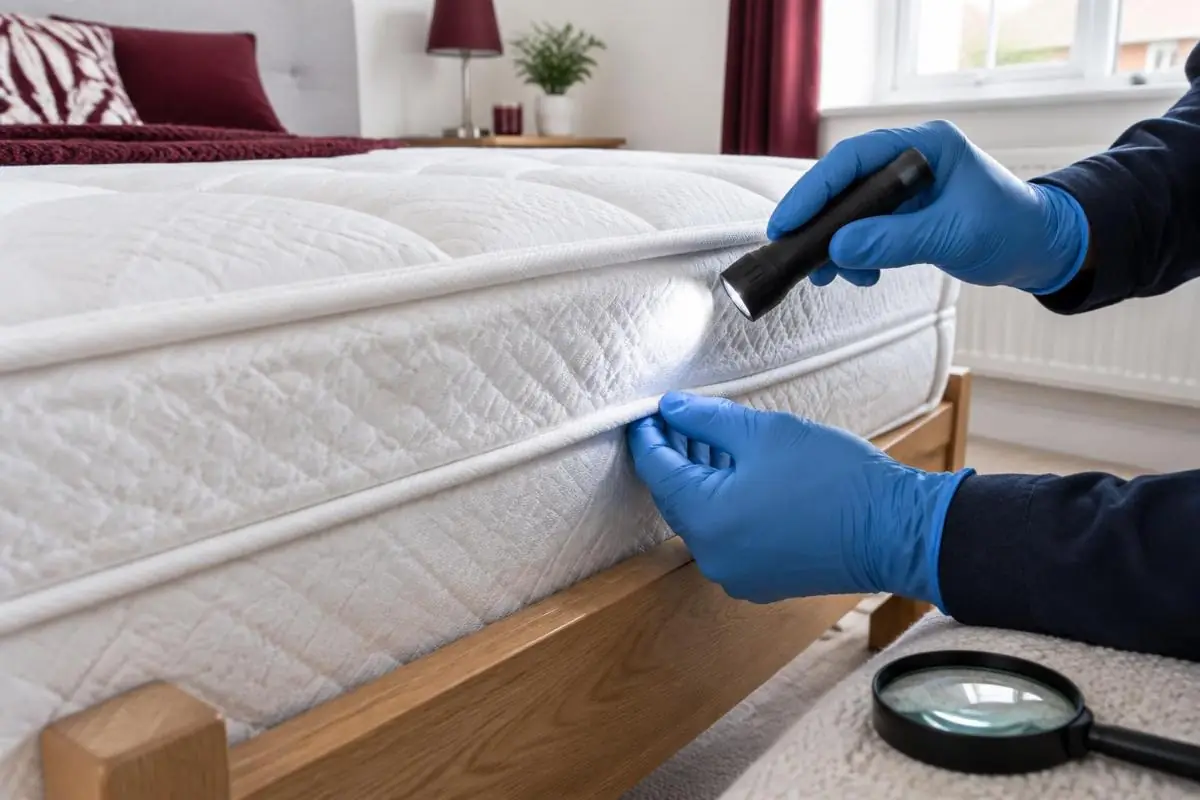
Start at one accessible corner and work around the mattress edge in a consistent direction. Use the torch to illuminate the stitched seam and the places where material folds together. Move slowly enough to distinguish a loose fibre or fragment from an insect. A systematic route is more useful than repeatedly checking whichever patch looks worrying.
Move bedding back only as far as necessary to see the area you are checking. Keep it at the bed rather than carrying it through other rooms during the inspection. If you notice something unfamiliar, pause before touching or brushing it away. First take a photograph that shows exactly where the finding sits.
Look along accessible seams, edging and fabric folds without cutting, tearing or pulling apart the mattress. Do not lift or turn a heavy mattress alone. If access is awkward, record which areas remain unchecked. This makes your account more accurate: 'accessible seams checked' is different from claiming that the whole mattress has been thoroughly examined and cleared.
Know what a mattress check cannot rule out
A mattress inspection has limits. The NHS identifies bedframes, clothing, pictures and loose wallpaper as possible hiding places. That means finding nothing along a mattress seam does not establish that the room is free of bed bugs. Equally, it does not justify treating every object in the room as contaminated without further evidence.
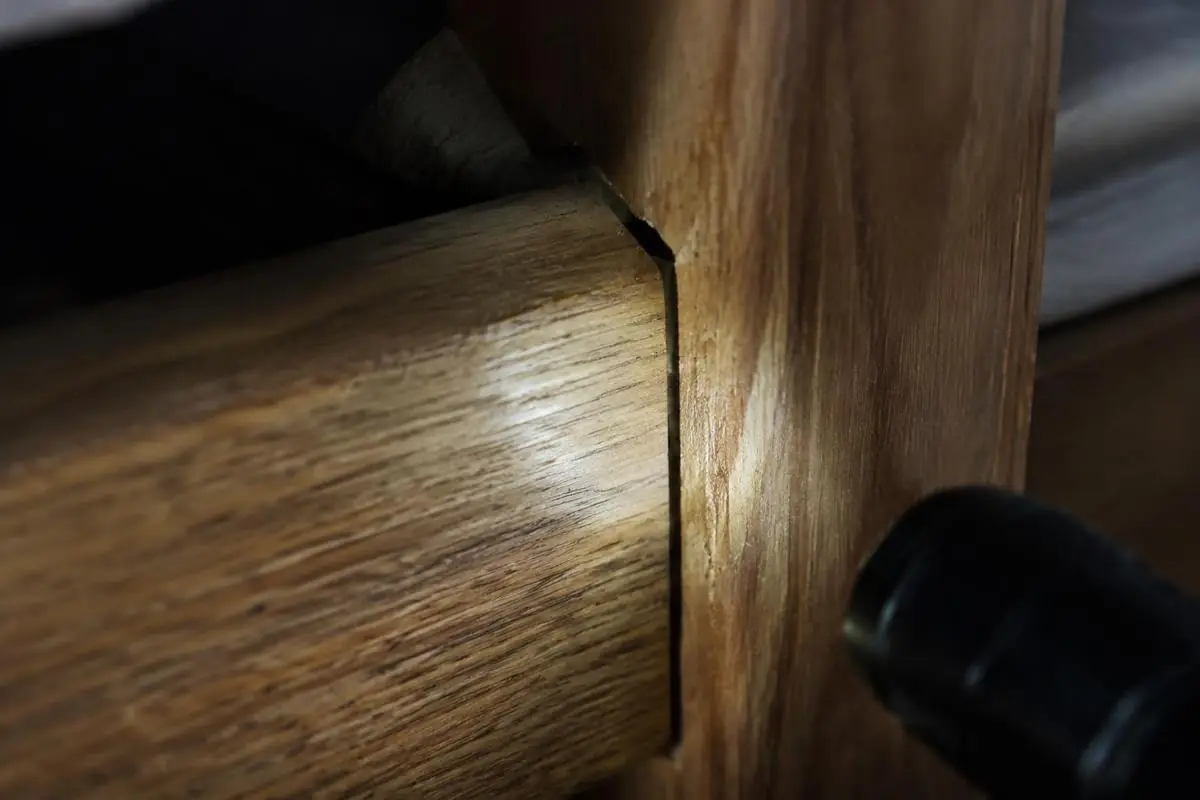
For this initial check, look at the visible bedframe immediately beside the mattress without taking it apart. Use the same method: observe, photograph anything uncertain and record the location. Leave inaccessible joints or awkward spaces for advice about an appropriate inspection. Do not remove socket covers, open appliances or improvise access around electrical fittings.
If your concern persists despite an uneventful mattress check, the next question is whether a broader inspection is warranted, not whether to dismantle the room yourself. Explain why you remain concerned and which areas you could access. A clear account of a limited inspection gives an adviser more useful information than an unsupported statement that you checked everything.
Photograph the location before the close-up
Take two kinds of photograph if you can: one showing the finding in its original position, and another showing its details. The wider image should establish the part of the mattress or bedframe involved. This matters because a close-up can show an insect clearly while giving no indication of where it was actually found.
For the detail image, steady the phone and use enough light to make the outline visible. Tap to focus if your camera allows it, and check the result before moving anything. Take another image if glare or shadow hides the body. Avoid relying on heavy digital zoom, filters or image enhancement that may obscure details.
Include a ruler beside a contained specimen where practical, without opening its container just to improve the shot. Keep an unedited original image as well as any crop you share. If the photograph remains indistinct, say so. A responsible assessment may require clearer images or inspection; a blurry image should not be treated as conclusive evidence either way.
For a property-specific assessment, see our bed bug heat treatment in Hertfordshire. Share your postcode and property details so the team can confirm coverage and availability.
Contain a specimen without carrying it around
If you can contain the insect safely and without chasing it through bedding, use a small clear container with a secure lid. Keep the task close to where you found it. Do not handle it on your skin for a photograph, and do not take loose specimens from room to room to show other people.
If capturing it would involve moving furniture, reaching into an unsafe gap or scattering belongings, stop at photographs and a location note. Preserving evidence does not justify an unsafe manoeuvre. Avoid crushing a specimen simply to stop uncertainty; damage can make its visible features harder to assess. Containment should remain a modest, controlled action.
Label the closed container with the date and location, and keep it somewhere secure away from children and pets. Tell an adviser that you have a contained specimen and ask how they want it assessed. Do not post or deliver it without instructions. If it escapes or is lost, report that plainly rather than presenting the photographs as more definitive than they are.
Make a household record without spreading alarm
A short written record should identify the room, the exact finding place, the date and what you observed. Add photograph filenames if that helps keep the information together. Separate your observations from other people's reports. 'Insect photographed on left mattress seam' communicates more than 'bed bugs everywhere', especially when only one area has been checked.
Agree on one place to keep photographs and notes so household members do not have to repeat the same inspection. Ask people not to move suspect bedding or furniture into another room while you seek advice. Explain this as a precaution to limit unnecessary movement, not as proof that all possessions have become affected.
Use neutral language with children, visitors and anyone sharing the bed. You can say, 'We found something we need help identifying; we are keeping it contained.' Avoid blaming a person, journey or purchase without evidence. The immediate task is to establish what was found and choose the next step, not to reconstruct an unproven source or assign responsibility.
Related practical reading: Bed bug eggs and life stages: why an inspection needs detail
Choose identification before cleaning or treatment
Match your next action to the strength of the evidence. A clear specimen deserves an identification enquiry. An unclear photograph deserves a request for better evidence or inspection. Skin marks alone do not establish bed bugs. With no finding, record the limits of your check rather than buying treatment to resolve uncertainty.
Do not let a precautionary inspection turn into improvised treatment. The US Environmental Protection Agency describes bed bug control as complex and warns against DIY space-heater treatment. Its technical guidance also explains that household heating is not reliable. These are safety and control references, not UK legal requirements, and they do not support heating a room yourself.
Cleaning cannot alone guarantee removal, and cleaning away the finding before documenting it can leave you with less information. Preserve useful evidence first where safe. If bed bugs are identified, ask what further assessment is needed before discussing a treatment plan. Neither a product purchase nor a proposed professional treatment should substitute for explaining the basis of the identification.
Send a focused enquiry and agree the next check
Prepare an enquiry with the original photographs, the approximate size, the exact finding location and the areas you inspected. State whether a specimen is securely contained. Ask: 'Can these images support identification?', 'What remains uncertain?' and 'Would an inspection be needed?' Those questions keep the conversation grounded in evidence rather than an assumption that treatment is already necessary.
For a service enquiry in Hertfordshire, Bed Bug Heat Control UK can be contacted on 0800 274 0156 or info@bedbugheatcontroluk.co.uk, from 7am–10pm Monday–Sunday. Explain that you are seeking identification guidance or assessment. An enquiry is not a booking, and any quote is property-specific; the information you provide should help clarify the appropriate next step.
Before ending the conversation, agree what to leave undisturbed, whether further photographs would help and how any specimen should be handled. If treatment is discussed, ask why it is recommended and what assessment supports it. For now, keep your record together, avoid moving suspect items unnecessarily and stop repeating disruptive searches while you await a clear plan.
Sources & further guidance
General information, not a diagnosis, medical advice or legal advice. Research and US EPA references provide technical background, not UK law, and do not endorse our company. Your property assessment and the team’s written preparation instructions take priority.